

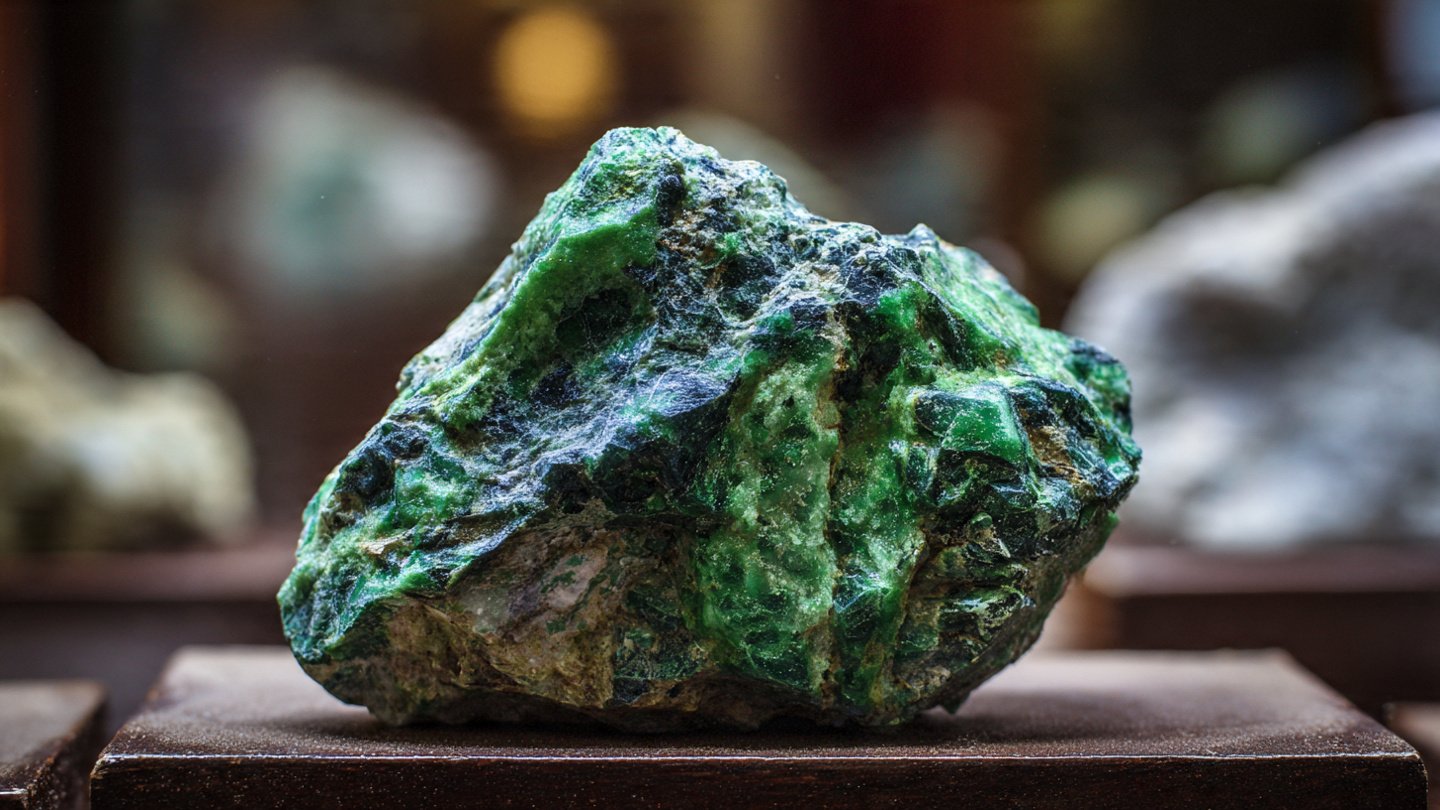
When you admire a piece of jade jewelry or a carved jade ornament, you’re looking at one of nature’s most fascinating mineralogical mysteries. What exactly is jade mineral? How does this natural stone jade form deep within the earth? What makes jade material so uniquely durable yet beautiful? Let’s explore the scientific side of jade—from its jade chemical formula to how jade ore is found in nature—and discover why this jade gem has captivated humanity for millennia.
What Is Jade Mineral? The Two-Stone Mystery
Here’s something that surprises most people: “jade” isn’t actually a single mineral. The term “jade” refers to two completely different minerals that look remarkably similar but have distinct chemical compositions and structures.
The Two Types of Jade Mineral
Jadeite: A pyroxene mineral and the rarer, more valuable form of jade
Nephrite: An amphibole mineral, more abundant and historically significant
Both qualify as jade material because they share similar physical properties—exceptional toughness, smooth texture, and the ability to take a high polish—even though they’re scientifically distinct minerals. This dual identity makes jade unique in the gemstone world.
Jadeite: The Jade Chemical Formula and Structure
Jadeite is a sodium aluminum silicate mineral with a specific jade chemical formula that defines its composition.
Jadeite Chemical Formula
The jade chemical formula for jadeite is: NaAlSi₂O₆
Breaking this down:
- Na: Sodium
- Al: Aluminum
- Si₂O₆: Silicon and oxygen (silicate group)
This jade chemical formula tells us that jadeite belongs to the pyroxene mineral group, specifically the alkali pyroxenes. The presence of sodium gives jadeite its unique properties and distinguishes it from nephrite jade.
Jadeite Crystal Structure
Jadeite forms in a monoclinic crystal system, meaning its crystals have three unequal axes with one oblique intersection. However, individual jadeite crystals are microscopically small. What we see as jade gem material is actually an aggregate of countless interlocking jadeite crystals—this structure explains jade’s legendary toughness.
The jadeite mineral structure consists of:
- Tightly interlocking crystal fibers: Creating exceptional durability
- Dense crystalline network: Resulting in high specific gravity (3.3-3.5)
- Variable crystal orientation: Contributing to jade’s distinctive texture
Jadeite Physical Properties
Understanding jadeite as a jade mineral means knowing its measurable characteristics:
Hardness: 6.5-7 on the Mohs scale (harder than steel, softer than quartz)
Specific Gravity: 3.30-3.38 (noticeably heavy for its size)
Toughness: Exceptional—one of the toughest natural materials known
Luster: Vitreous to greasy when polished
Transparency: Ranges from transparent to opaque
Cleavage: Imperfect, contributing to its toughness
Fracture: Splintery to uneven
These properties make jadeite jade material ideal for both jewelry and carving, withstanding wear that would damage softer stones.
Color Variations in Jadeite Mineral
The jade chemical formula for pure jadeite would produce colorless or white material. The vibrant colors we associate with jade gem quality material come from trace elements substituting into the crystal structure:
Chromium: Creates the prized emerald-green “Imperial jade”
Iron: Produces various green shades, as well as brown, yellow, and red
Manganese: Results in lavender and violet hues
Titanium: Contributes to violet and blue colors
The specific combination and concentration of these trace elements determine the final color of the jade material, making each piece unique.
Nephrite: The Alternative Jade Mineral
Nephrite jade mineral has a completely different jade chemical formula and structure from jadeite, yet both are recognized as authentic jade.
Nephrite Chemical Formula
The jade chemical formula for nephrite is more complex: Ca₂(Mg,Fe)₅Si₈O₂₂(OH)₂
This formula indicates:
- Ca₂: Calcium
- (Mg,Fe)₅: Magnesium and/or iron (varying proportions)
- Si₈O₂₂: Silicon and oxygen (silicate structure)
- (OH)₂: Hydroxyl groups
Nephrite belongs to the amphibole mineral group, specifically forming from either actinolite or tremolite minerals. The jade chemical formula shows it’s a calcium magnesium iron silicate—quite different from jadeite’s sodium aluminum silicate composition.
Nephrite Crystal Structure
Nephrite jade mineral forms in a monoclinic crystal system, but its structure differs significantly from jadeite:
- Fibrous crystal habit: Nephrite consists of densely packed, interwoven fiber-like crystals
- Feltlike texture: The matted fibers create an extraordinarily tough structure
- Slightly lower density: Specific gravity of 2.90-3.03 (lighter than jadeite)
This fibrous structure makes nephrite jade material even tougher than jadeite, though generally less translucent.
Nephrite Physical Properties
The nephrite jade mineral exhibits these characteristics:
Hardness: 6-6.5 on the Mohs scale (slightly softer than jadeite)
Specific Gravity: 2.90-3.03 (lighter than jadeite)
Toughness: Exceptional—actually tougher than jadeite due to fiber structure
Luster: Greasy to waxy when polished
Transparency: Typically translucent to opaque (rarely semi-transparent)
Cleavage: Perfect in two directions (but rarely observed due to fibrous nature)
Fracture: Splintery
While slightly softer than jadeite, nephrite’s fibrous structure makes it more resistant to breaking—ancient peoples used nephrite for tools and weapons because of this incredible toughness.
Nephrite Color Range
Pure tremolite (the mineral that forms white nephrite) is colorless, while pure actinolite is green. The color of nephrite jade material depends on the iron content:
Low iron content: White to cream-colored jade (like “mutton fat” jade)
Moderate iron: Light to medium green shades
High iron: Deep green to near-black jade material
Oxidized iron: Brown, yellow, and reddish tones
Nephrite generally shows more muted, earthy colors compared to the vivid hues possible in jadeite jade gem material.
Where Did Jade Come From? Formation and Geology
Understanding where did jade come from requires exploring the geological processes that create this natural stone jade.
How Jadeite Forms: High-Pressure Metamorphism
Jadeite jade mineral forms under extreme conditions deep within the earth:
Tectonic Setting: Jadeite primarily forms in subduction zones where oceanic crust plunges beneath continental crust.
Pressure Requirements: Forms at pressures of 7,000-15,000 atmospheres (equivalent to depths of 15-35 kilometers)
Temperature Range: Relatively low temperatures of 200-300°C (unusual for such depths)
Parent Material: Forms from sodium-rich basaltic rocks or sediments undergoing metamorphism
This combination of high pressure and relatively low temperature creates the conditions where jadeite jade mineral crystallizes. The rock must then be brought back to the earth’s surface through tectonic uplift and erosion—a journey that can take millions of years.
Jadeite Host Rocks
Jadeite jade ore is typically found in:
Serpentinite: The most common host rock for jadeite
Blueschist and Eclogite: High-pressure metamorphic rocks that sometimes contain jadeite
Alluvial Deposits: River gravels where erosion has freed jadeite from host rocks
The jade ore in Myanmar, the world’s premier jadeite source, occurs primarily in serpentinite formations that were uplifted and exposed through millions of years of geological activity.
How Nephrite Forms: Contact Metamorphism
Nephrite jade mineral forms through different geological processes:
Formation Setting: Typically forms where ultramafic rocks (like serpentinite) contact other rock types
Metamorphic Process: Results from contact metamorphism or regional metamorphism of magnesium-rich rocks
Temperature and Pressure: Forms at lower pressures than jadeite but often higher temperatures
Chemical Process: Hot, mineral-rich fluids alter existing minerals (tremolite or actinolite) into the dense, fibrous jade material
Where did jade come from in traditional Chinese sources? Ancient Chinese nephrite jade ore formed when granitic magmas intruded into dolomitic limestone, creating the contact metamorphic conditions that produced nephrite in regions like Hotan and Kunlun Mountains.
Nephrite Host Rocks
Natural stone jade in the form of nephrite occurs in:
Serpentinite: Common host rock for nephrite
Metamorphosed Dolomite: Especially in Chinese deposits
Schist and Gneiss: Metamorphic rocks that sometimes contain nephrite
River Deposits: Alluvial jade ore transported by water erosion
Nephrite jade ore is more widely distributed geographically than jadeite because the geological conditions for its formation are less restrictive.
Jade Ore: From Earth to Extraction
Understanding jade mineral includes knowing how this jade ore is found and extracted from the earth.
Primary Jade Deposits
Primary deposits contain jade mineral still embedded in its original host rock:
Identification: Requires geological surveys, prospecting, and sometimes accidental discovery
Extraction: Involves quarrying or mining operations to remove jade-bearing rock
Processing: Requires cutting away host rock to reveal jade material
Quality: Can yield large, intact pieces of jade gem material
Primary jade ore deposits are valuable because they provide fresh, unweathered jade mineral with original colors and characteristics.
Secondary (Alluvial) Deposits
Many significant jade finds come from secondary deposits:
River Gravels: Natural erosion frees jade from host rocks and deposits it in rivers
Ancient Riverbeds: Former waterways may contain concentrated jade ore
Boulder Fields: Weathering can create areas where jade boulders accumulate
Beach Deposits: Coastal areas sometimes yield jade material from offshore deposits
Traditional jade hunting often focuses on rivers and streams where distinctive jade boulders can be spotted among other rocks. Where did jade come from for ancient peoples? Often from rivers where natural stone jade was easier to find and collect than mining primary deposits.
Identifying Jade Ore in Nature
Experienced prospectors identify potential jade material by:
Weight: Jade’s high density makes it noticeably heavier than most rocks
Appearance: Jade ore often has a distinctive waxy or greasy surface luster
Sound: Jade produces a distinctive musical tone when struck
Texture: The smooth, fine-grained texture differs from common rocks
Color: While not always obvious, jade’s colors can indicate its presence
Skin/Rind: Weathered jade often develops a distinctive outer layer or “skin”
Jade Material: Physical Properties Explained
The exceptional properties of jade material arise from its unique mineralogical structure.
Why Is Jade So Tough?
Both jadeite and nephrite jade mineral are renowned for exceptional toughness—the resistance to breaking or fracturing. This jade material toughness exceeds almost all other gemstones and even most metals.
Jadeite Toughness: Results from tightly interlocking microscopic crystals that distribute stress throughout the stone. Breaking jadeite requires fracturing countless individual crystals and their bonds.
Nephrite Toughness: Comes from densely matted fiber-like crystals that act like natural reinforcement. The fibrous structure prevents cracks from propagating, similar to fiberglass or carbon fiber composites.
This is why ancient peoples worldwide used jade for tools, weapons, and ceremonial objects—this natural stone jade could withstand impacts that would shatter most other rocks.
Jade’s Unique Texture
The jade material texture that makes jade so recognizable comes from its crystal structure:
Fine-Grained: Individual crystals are microscopic, creating smooth surfaces
Uniform: Even crystal distribution produces consistent texture
Dense: Tightly packed crystals leave no voids or pores
Polishable: The structure accepts and maintains a high polish
The finest jade gem material has such fine texture it feels almost buttery or soapy to touch, despite being harder than steel.
Working with Jade Material
Jade’s properties affect how artisans work with it:
Cutting: Requires diamond-tipped tools due to hardness
Carving: Responds well to abrasives; traditionally carved using sand and water
Polishing: Takes exceptional polish, revealing depth and translucency
Durability: Finished jade jewelry and carvings last for generations without degradation
Understanding jade as a mineral helps artisans and collectors appreciate the skill required to transform rough jade ore into beautiful jade gem creations.
Distinguishing Jadeite from Nephrite
Since both minerals are called jade, how can you tell them apart?
Visual Differences
Jadeite: Often more translucent, can show more vivid colors, may have a glassy appearance
Nephrite: Typically more opaque, shows softer/earthier colors, has a greasy or waxy luster
However, visual inspection alone is often insufficient for definitive identification.
Physical Tests
Specific Gravity: Jadeite (3.3-3.5) is noticeably heavier than nephrite (2.9-3.0)
Hardness: Jadeite (6.5-7) is slightly harder than nephrite (6-6.5)
Sound Test: When tapped, jadeite produces a higher, more musical tone than nephrite
Scientific Analysis
Definitive identification requires:
Spectroscopy: Analyzes how the jade material interacts with light
X-ray Diffraction: Identifies the crystal structure definitively
Refractive Index: Measures light bending (Jadeite: 1.66-1.68; Nephrite: 1.60-1.63)
Chemical Analysis: Determines the exact jade chemical formula
Professional gemological laboratories like GIA can definitively identify jade mineral type through these scientific methods.
Jade Gem Quality: What Makes Premium Jade Material
Not all jade mineral becomes jade gem quality material. Several factors determine whether jade ore becomes valuable jade material:
Color
The most important factor in jade gem valuation:
- Intensity and saturation
- Uniformity throughout the stone
- Absence of undesirable secondary colors
Transparency
Higher translucency increases value:
- Light penetrates the jade material
- Creates a glowing, luminous appearance
- Most valuable jade shows semi-transparency
Texture
Finer texture indicates premium jade mineral:
- Smooth, even grain structure
- No visible crystal boundaries
- Uniform throughout
Clarity
Freedom from flaws enhances value:
- No visible cracks or fractures
- Absence of black spots or inclusions
- Consistent appearance
Natural Stone Jade vs. Treated Material
Understanding jade mineral includes recognizing treatments that alter natural stone jade:
Type A (Natural)
Completely natural jade mineral with only surface waxing. The jade chemical formula and structure remain unchanged. This represents authentic natural stone jade and commands premium prices.
Type B (Bleached and Impregnated)
Jade material chemically treated to remove impurities and filled with polymer resin. While still genuine jade mineral by composition, the treatment alters its natural properties and significantly reduces value.
Type C (Dyed)
Natural stone jade that has been artificially colored. The jade chemical formula remains correct, but colors don’t occur naturally.
Type B+C (Bleached, Filled, and Dyed)
Multiple treatments create artificial appearance. Worth only a fraction of natural stone jade prices despite being genuine jade mineral.
Always seek Type A natural stone jade for jewelry and collections. Reputable dealers disclose treatments.
Conclusion
Understanding jade mineral—from its jade chemical formula to how jade ore forms—reveals why this natural stone jade has fascinated humanity for millennia. Two distinct minerals (jadeite: NaAlSi₂O₆ and nephrite: Ca₂(Mg,Fe)₅Si₈O₂₂(OH)₂) both create exceptional jade material through millions of years of geological transformation.
Where did jade come from? From deep within the earth under extreme pressure and specific conditions that rarely occur in nature. Whether you’re admiring a vibrant jade gem or studying jade ore deposits, you’re witnessing a mineralogical marvel—nature’s perfect combination of chemistry, structure, and beauty that makes jade truly unique among gemstones.


